
From the Strago team · Fourth in a weekly series
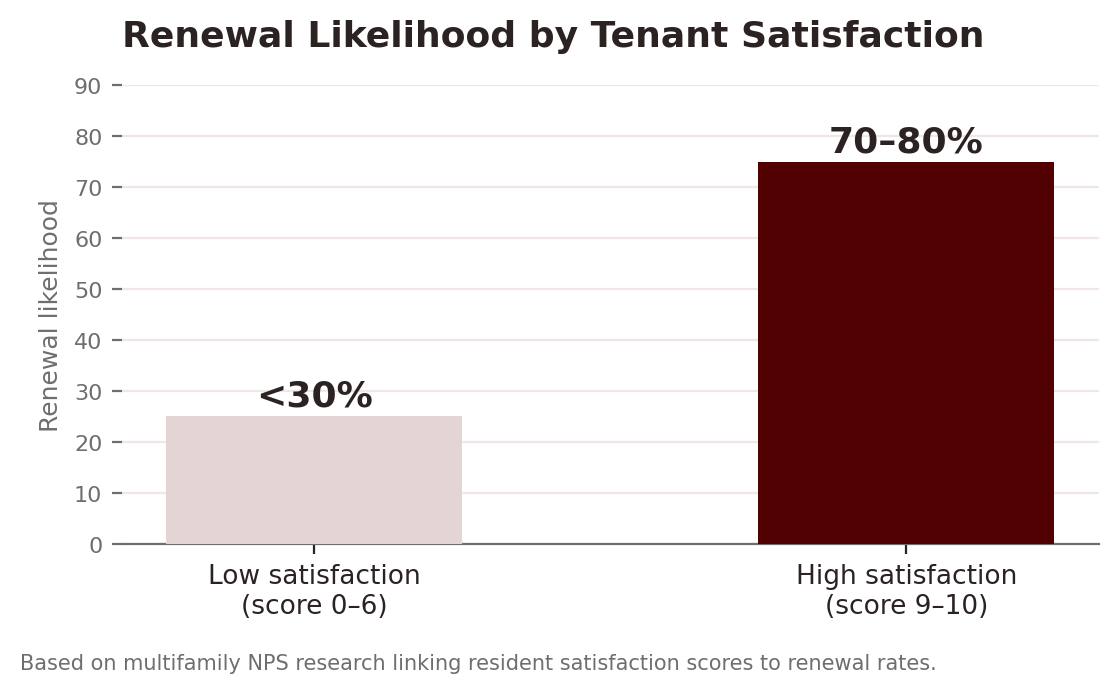
Ask most owners why a tenant didn't renew and the first guess is almost always rent. It's the easiest answer, and sometimes it's even true. But the data tells a more useful story: tenants who report being satisfied with where they live are roughly 73 percent more likely to plan on renewing than tenants who report being dissatisfied, and satisfaction has surprisingly little to do with the monthly rent figure. It has much more to do with how quickly a maintenance request gets answered, how a property manager communicates, and a handful of small decisions that happen mid-lease, long before anyone sends a renewal notice.
This week's guide breaks down what actually predicts renewal in a market like College Station, and what a property manager can do differently to keep good tenants from quietly starting to browse listings again.
It's Rarely About the Rent
Renewal decisions are shaped by an accumulation of small experiences across the lease, not a single line-item comparison against market rent. Tenant satisfaction research consistently finds that residents who rate their experience highly renew at dramatically higher rates than those who don't, and the gap is large enough that it outweighs modest rent increases in most cases. A one-point improvement in overall satisfaction score has been linked to roughly an 8.5 percent increase in renewal likelihood on its own.
The uncomfortable part for owners is that by the time an annual survey shows a low score, many tenants have already made their decision. Satisfaction problems tend to build quietly over months before they ever show up in a formal review.
Maintenance Response Times Matter More Than People Think
Maintenance is where renewal decisions are quietly won or lost. Industry data suggests more than 40 percent of tenant-landlord disputes trace back to delayed repairs, and separate research found that roughly 31 percent of tenants who were on the fence about renewing said they would stay if maintenance service simply improved. That is a meaningful share of undecided renters being nudged one direction or the other by response time alone.
Speed matters, but so does acknowledgment. A tenant who hears back within the hour, even if the actual repair takes a few days, generally reports far less frustration than one who hears nothing and then gets a fix a day later. The waiting is what erodes trust, not the repair timeline itself.
| Priority | Response | Resolution Target |
|---|---|---|
| Emergency (no heat, active leak, no power) | Within 1 hour | Dispatch within 4 hours |
| Urgent (appliance failure, minor leak) | Within 24 hours | Resolved within 48 hours |
| Routine (cosmetic, non-urgent repair) | Within 24–48 hours | Scheduled within the week |
Communication Habits That Quietly Build Trust
How a property manager communicates matters almost as much as what gets communicated. Renter preference research consistently shows text messaging is the most preferred communication channel across age groups, generally in the high 60s to mid 70s percent range, while tenant portals alone rank near the bottom, often in the single digits to low teens. A maintenance update sent as a portal notification a tenant has to log in to see does far less for the relationship than a short text saying the part has been ordered and a technician is scheduled.
The first 30 days of a lease also carry outsized weight. Move-in experience tends to set the tone for the entire tenancy, and dissatisfaction that starts early is difficult to fully reverse later, even with strong service afterward.
The Renewal Timeline Matters As Much As the Terms
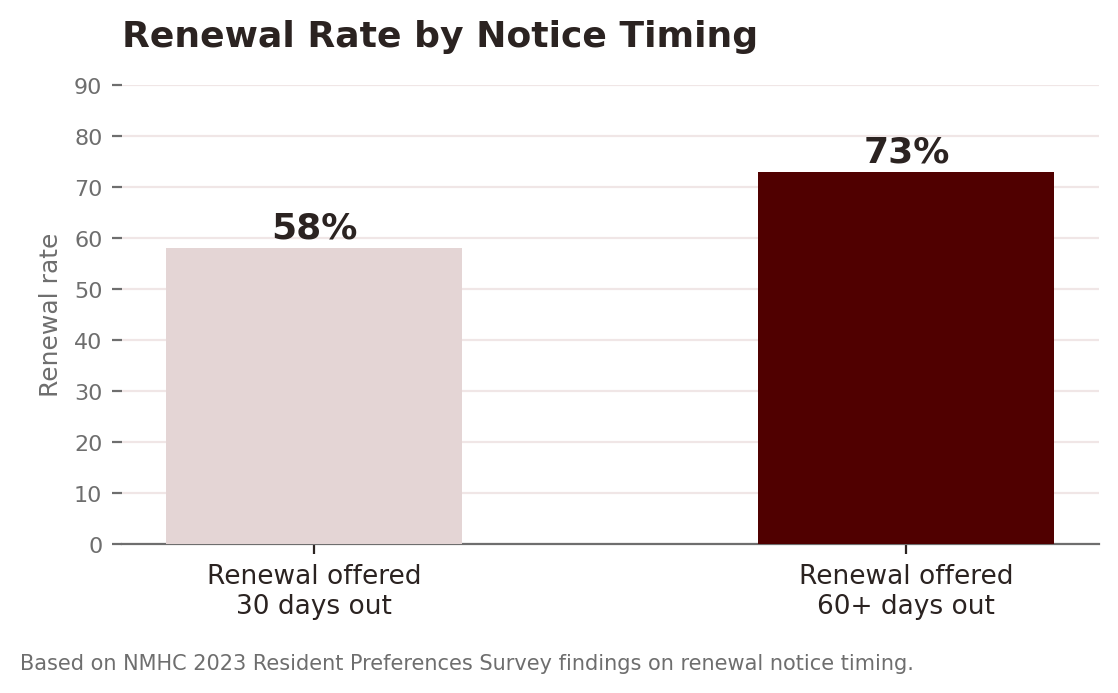
Even the timing of the renewal offer itself changes the outcome. Survey research on renewal timing found that tenants who received their renewal terms 60 or more days before lease expiration renewed at meaningfully higher rates than tenants who received the same terms only 30 days out, on the same units, at the same rent. The only real difference was how much runway the tenant had to decide before feeling pressured to start looking elsewhere out of caution.
Small Property Management Decisions That Add Up
- Acknowledging a maintenance request within the hour, even before a technician is scheduled.
- Sending a short proactive update mid-repair instead of going quiet until it's finished.
- Defaulting to text for routine updates rather than relying on a portal alone.
- Sending renewal terms 60 or more days ahead of lease expiration instead of waiting until 30.
- Following up after a maintenance visit to confirm the fix actually held.
- Treating the first 30 days of a new lease as the highest-stakes stretch of the whole tenancy.
A Renewal Readiness Checklist for Owners
- Maintenance requests are acknowledged within one hour, even for non-emergencies.
- Emergency issues get a technician dispatched within four hours.
- Tenants receive proactive updates during multi-day repairs, not just a final confirmation.
- Renewal terms go out at least 60 days before lease expiration, not 30.
- Communication defaults to text or phone, with the portal as a backup, not the primary channel.
- New tenants get a check-in within the first two weeks of move-in, not just at renewal time.
What Actually Predicts Renewal
| Moves the Needle | Rarely Moves the Needle Much |
|---|---|
| Fast, acknowledged maintenance response | A small rent discount alone |
| Proactive updates during repairs | A longer lease term with no other change |
| Renewal terms sent 60+ days out | Cosmetic upgrades tenants didn't ask for |
| A strong first 30 days after move-in | An annual survey with no follow-up action |
| Text-based, responsive communication | Portal-only communication |
Frequently Asked Questions
Does lowering rent actually improve tenant renewal rates?
Rent plays a role, but satisfaction with maintenance response and communication tends to have a larger effect on renewal likelihood than modest rent adjustments alone.
How quickly should a maintenance request be acknowledged?
Best practice is acknowledgment within one hour for any request, with emergencies dispatched within four hours, even if the full repair takes longer to complete.
How far in advance should renewal terms be sent?
Sending renewal terms at least 60 days before lease expiration is associated with meaningfully higher renewal rates than waiting until the standard 30-day mark.
Does Strago handle tenant communication and maintenance response for owners?
Strago Properties provides full-service management for owners across College Station, including Southside, Eastgate, Wolf Pen Creek, and the East Medical District, handling tenant placement, maintenance response, and communication as part of day-to-day management.
Next week, we're shifting gears to short-term rentals: what College Station's permitting rules actually require, how game weekends and graduation change the math, and whether an STR or a traditional lease makes more sense for a given property. In the meantime, the Strago team is glad to help with anything you are working through. Reach out anytime at stragopm.com.
Integrity First. Family Owned. Aggie Built.