
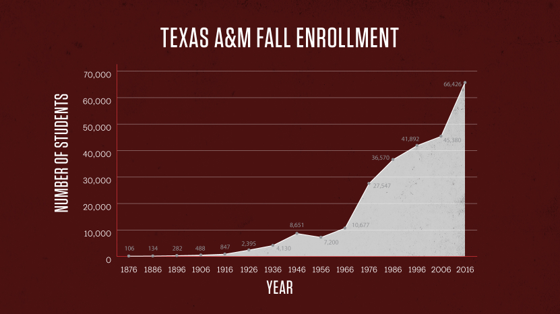
140 years of growth at Texas A&M, now facing a proposed pause
Every rental market conversation in this town runs on the same logic: A&M keeps growing, so demand keeps growing. That's getting complicated. A university committee wants to slow enrollment down right as the city is mid-build on the biggest wave of rental housing it's ever seen.
A Decade of Growth, and a Proposed Pause
Texas A&M's College Station campus grew roughly 30 percent over the past decade, adding close to 18,000 students and pushing enrollment past 71,000, a pace university leadership has called more than double the average growth rate of other public universities in the state. That growth outran the infrastructure built to support it. A university capacity study cited deficiencies in student housing, dining, parking, transportation, and even the faculty-to-student ratio.
In response, a university committee recommended holding new undergraduate enrollment at the College Station campus to around 15,000 a year for five to seven years, effectively a growth pause, while the university catches its infrastructure up to the student body it already has. Thousands of qualified applicants are already being turned away each year in high-demand majors like engineering and business, not for lack of interest, but for lack of room.
Meanwhile, the City Is Building Like Growth Never Stopped
So here's the mismatch: the university is talking about slowing down, and College Station and Bryan are building like it's still 2019. A 24-story, 342-unit tower is going up in Northgate. There's a 12-building, 324,000-square-foot complex underway near Legacy Point. About 222 acres on Greens Prairie Road just got rezoned for up to 886 homes. And Bryan has multiple multifamily and student housing projects moving through approval right now, too.
None of this development happens overnight, and none of it gets undone overnight either. Most of these projects were planned years ago, when the growth curve looked like it would keep climbing indefinitely. A multi-year enrollment pause, if it actually happens, would land right in the middle of that construction pipeline finishing up.
What This Could Mean
If Enrollment Growth Pauses | What It Could Mean for the Rental Market |
Undergraduate enrollment holds flat for 5–7 years | Student-driven rental demand growth slows alongside it |
New housing supply keeps completing through 2028 | More units competing for a more stable pool of renters |
Graduate and professional programs still grow | Some offsetting demand from grad students and staff |
University focuses on infrastructure, not expansion | Long-term demand outlook depends on what comes after the pause |
What This Means for Landlords
- A slower enrollment trajectory doesn't mean a shrinking market, it means a market that may absorb new supply more slowly than the last decade would suggest.
- Properties competing directly with new large-scale developments may feel more pricing pressure over the next few years than properties in less-contested areas.
- Graduate program growth, which has outpaced undergraduate growth recently, may be a more reliable long-term demand driver than headline enrollment alone.
- This is a proposed pause, not a guaranteed one. Worth watching how it actually plays out rather than assuming it's settled.
Where Strago Fits In
Understanding how supply and demand are actually moving, not just the assumption that this market only ever grows, is exactly the kind of thing that shapes a smart pricing and leasing strategy. Strago Properties manages traditional and short-term rentals across College Station, Bryan, and Navasota, with Grimes County also part of our service area, and we watch shifts like this closely for our owners.
Frequently Asked Questions
Is Texas A&M actually reducing enrollment?
Not reducing. A university committee has recommended holding new undergraduate enrollment at the College Station campus to around 15,000 a year for five to seven years, essentially a growth pause rather than a cut.
Why is the university considering this?
A capacity study found that a decade of rapid growth outpaced infrastructure like housing, dining, parking, and transportation, and recommended a pause to let facilities catch up.
Does this mean new rental construction in College Station is a mistake?
Not necessarily. Most current projects were planned years ago, and graduate enrollment continues growing even amid undergraduate caps, but it's a real factor worth weighing for anyone evaluating new rental investment tied to student demand.
Does Strago track shifts like this for property owners?
Yes. Strago Properties manages traditional and short-term rentals across College Station, Bryan, Navasota, and Grimes County, and factors trends like this into how we advise owners on pricing and positioning.
Wondering how this shift could affect your property's positioning? The Strago team is glad to help you think it through. Reach out anytime at stragopm.com.
Integrity First. Family Owned. Aggie Built.
Strago Properties | stragopm.com